Personal Boundaries That Protect Your Peace (No Guilt)

Boundaries That Protect Your Peace: Strengthen Personal Limits and Build Emotional Confidence
Personal boundaries are the limits that define what feels safe, respectful, and sustainable in relationships, work, and daily life. Strong boundaries reduce resentment, prevent burnout, and make it easier to show up with clarity and calm. This guide breaks boundaries into practical, learnable skills—so limits can be set without guilt, explained without over-justifying, and maintained even when others push back.
What personal boundaries actually do
Boundaries aren’t walls; they’re guidelines for access, expectations, and respect. When they’re clear, relationships require less guessing—and less cleanup after uncomfortable moments.
- Clarify what is acceptable (and what is not) in words, time, touch, and emotional labor
- Prevent chronic stress patterns like people-pleasing, over-explaining, and emotional over-functioning
- Support healthier relationships by replacing mind-reading with clear expectations
- Build self-trust: confidence grows when actions consistently match values
Stress that lingers after repeated “small” oversteps adds up. For a deeper look at how stress affects the body and mind, see the American Psychological Association (APA) overview of stress and Mayo Clinic’s stress management basics.
Common signs a boundary is needed
Often, the first clue isn’t a dramatic conflict—it’s a pattern of internal tension. If these show up repeatedly, a boundary likely belongs there.
- Frequent irritation or resentment after interactions, even with people who mean well
- Feeling responsible for others’ moods, outcomes, or comfort at the expense of personal needs
- Saying “yes” quickly, then regretting it or trying to back out later
- Dreading messages/calls because responses feel urgent or demanding
- Replaying conversations and wishing something had been said differently
Types of boundaries and real-life examples
Different situations call for different boundary “lanes.” Knowing the type helps you choose a sentence that’s short, specific, and hard to misinterpret.
| Boundary type | Protects | Example boundary statement |
|---|---|---|
| Time | Energy, priorities, recovery | “I’m available to talk for 15 minutes today; after that I need to get back to work.” |
| Emotional | Mental health, responsibility lines | “I care about you, but I can’t be the person you vent to every night.” |
| Physical | Safety, comfort, autonomy | “Please don’t hug me without asking first.” |
| Digital | Attention, interruption control | “I don’t respond to messages after 8 pm; I’ll reply tomorrow.” |
| Financial | Security, fairness, expectations | “I’m not able to lend money, but I can help you plan next steps.” |
A simple method to set boundaries without guilt
Guilt usually spikes when boundaries sound like a debate. A calmer approach is to state what’s happening, state the limit, and then stop talking.
- Name the situation: describe what’s happening in neutral language (no character judgments).
- State the limit: one clear sentence; avoid long backstories that invite negotiation.
- Offer an option (when appropriate): a choice that still honors the limit.
- Repeat the boundary: use the same wording; consistency reduces escalation.
- Follow through: boundaries are maintained by actions, not by perfect explanations.
If it helps, think of a boundary as a policy, not a mood. Policies don’t require constant justification; they require consistent application.
Scripts for hard moments (and how to keep them short)
Short scripts reduce over-explaining, which can accidentally teach others that “no” is temporary if they keep asking. Aim for calm, simple, and repeatable.
- When someone presses for reasons: “I’m not able to, but I hope it goes well.”
- When a request is last-minute: “I need more notice for that. Ask me earlier next time.”
- When someone guilt-trips: “I understand you’re disappointed. My answer is still no.”
- When a conversation turns disrespectful: “I’m going to pause this. We can continue when it’s respectful.”
- When protecting private information: “I’m not discussing that.”
Building emotional confidence through boundary practice
Emotional confidence isn’t loudness; it’s steadiness. It grows when you see yourself handle discomfort without abandoning your needs.
- Start small: choose one low-stakes boundary to practice weekly (availability, response time, small favors).
- Track evidence: note what happened when a boundary was set; confidence grows from proof, not pep talks.
- Regulate before responding: breathe, pause, and answer after the nervous system settles.
- Normalize discomfort: guilt and anxiety can be “old programming,” not a sign of wrongdoing.
- Celebrate follow-through: even imperfect boundaries count when actions match the limit.
Handling pushback: what to do when others resist
Pushback doesn’t always mean you were unclear. Sometimes it means the old pattern benefited someone—and change is inconvenient.
Daily habits that protect peace long-term
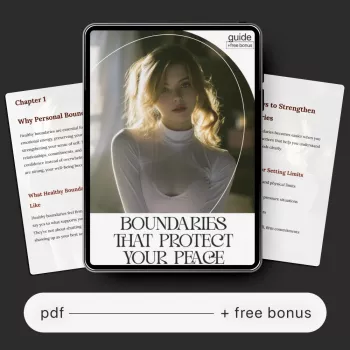
Guide to strengthen personal boundaries and emotional confidence
- Structured boundary support: Boundaries That Protect Your Peace | Guide on Ways to Strengthen Your Personal Boundaries and Build Emotional Confidence (digital guide)
- Whole-life support for steadier energy: Fuel Your Life: The Ultimate Healthy Eating Starter Bundle | 4-in-1 Bundle Digital Download | Healthy Eating PDF + Audio
FAQ
How do boundaries differ from being controlling or selfish?
Boundaries describe what you will do or accept (your time, access, and behavior), while control tries to dictate someone else’s choices. “I’m leaving if I’m yelled at” is a boundary; “You’re not allowed to be angry” is control.
What if setting boundaries makes someone angry?
Anger can be a reaction to changed access, not proof you did something wrong. Stay calm, repeat the boundary, and use a simple consequence (end the call, pause the conversation, respond later) if the pressure continues.
How can boundaries be set at work without harming relationships?
Use time-based limits, priority framing, and clear response windows: “I can take this on after I finish X, or we can move the deadline—what would you prefer?” For after-hours messages: “I’ll respond tomorrow during business hours unless it’s urgent and labeled as such.”










Leave a comment